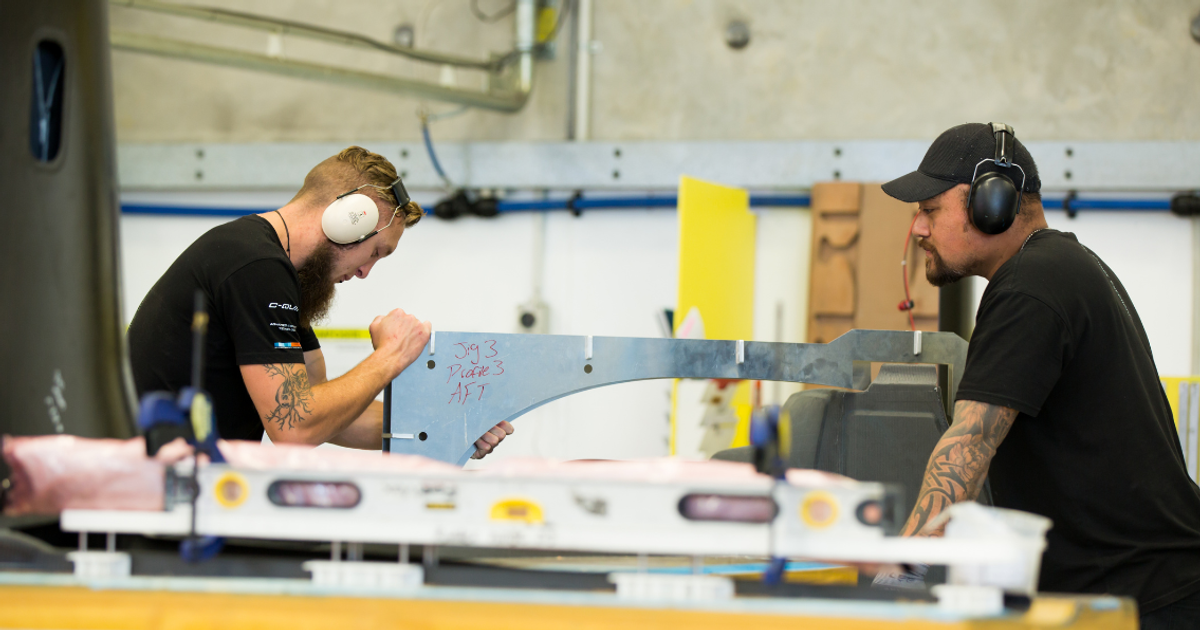
From Auckland to Monaco marinas, carbon-fibre creations from C-Quip have become the go-to finishing touch for super-yachts, commercial ships and even aerospace cabins. Here’s how a small New Zealand firm turned advanced composites into a global calling card—and why their weight-slashing, jaw-dropping parts are prized from ocean to orbit.
From ‘Too Far Away’ to Industry Favourite
When founder Paul Hackett first tried to crack Europe’s super-yacht scene in the early 2000s, the reception was polite… and sceptical.
“Most people loved the America’s Cup pedigree but still thought New Zealand was too risky and far away,” recalls the C-Quip team
After countless door-knocking trips, their break came in 2004–05 through yacht designer Sam Sorgiovanni and shipyard Oceanco. C-Quip supplied flawless carbon-fibre parts; Oceanco promptly began replacing traditional steel equipment on other builds. Word spread. Two decades on, C-Quip exports globally, their ISO 9001 factory shipping everything from boarding stairs to pilot ladders for 100 m-plus yachts, plus bespoke parts for clients like SpaceX, Rocket Lab and Michael Jordan.
The Carbon Advantage
C-Quip’s signature pieces—boarding stairs, dock steps, pilot ladders, swim stairs, tender fenders and custom light masts—share one trait: extreme strength-to-weight ratios.
- 12-step carbon boarding stairs can weigh 150 kg less than equivalent aluminium or steel.
- Reduced weight means lower fuel burn, simpler one-person deployment and less corrosion risk.
- Clear-coat carbon weave or custom colour-matched finishes turn everyday hardware into super-yacht jewellery.
Behind the glamour sits a deep tool-kit: autoclave and out-of-autoclave processing, 5-axis machining, epoxy and phenolic matrices – even ceramic composites for A60 fire-rated doors (the first carbon version in the world).
Bridging Art and Science
C-Quip’s design office looks as much like an art studio as a CAD bay. Sales Director Daniel Barnard, an ex-sail-yacht skipper, brings on-deck practicality; designers model in CATIA, run FEA load cases, then agonise over hand-sanded clear-coat finishes.
“We bridge the gap between art and science—delivering products that take your breath away while outperforming heavier metals,” the team explains.
That philosophy has won them cabin-interior work for Air New Zealand and Virgin Atlantic and attracted motorsport projects where every gram counts.
A Talent Pipeline Forged in Carbon
Finding composite talent can be tough, so C-Quip grows its own: a Level 4 NZQA composite apprenticeship funnels young technicians through lay-up, machining and QA disciplines. Graduates emerge able to vacuum-bag complex shapes one day and polish a show-grade clear-coat the next.
“Manufacturing lets you add real value to the world,” says the team. “The tech we use today offers limitless possibilities—you could be the first to build something that changes lives.”
Flagship Products at a Glance
Whether it’s self-levelling boarding stairs, carbon A60 doors, inflatable tender fenders, or next-generation pilot ladders, C-Quip applies the same formula: carbon-fibre shells, titanium or stainless details, and Kiwi problem-solving that turns utilitarian gear into precision art.
Sustainability by Design
Lightweight accessories cut displacement, letting yachts travel farther on less fuel. Long-life carbon means fewer replacements and less yard waste. And because the products are designed, built and finished under one roof, shipping emissions stay low until final delivery.
What’s Next?
C-Quip is scaling its aerospace work—think carbon crew-rest bunks and galley panels—and refining a new generation of hybrid composite + recycled-fibre parts aimed at reducing embodied carbon even further.
“We’ve shown the world what Kiwi composites can do in yachting,” says the team. “Now we’re taking that mindset into every sector that needs lighter, stronger, better-looking solutions.”
From a makeshift workshop to supplying the world’s most demanding yacht yards, and, yes, the occasional rocket – C-Quip proves high-value manufacturing thrives at the bottom of the world. Their secret? Relentless R&D, fearless sales trips and a team that sees no divide between precision engineering and pure craft.
“New Zealand, we are the future makers,” they declare. “And carbon fibre is just the beginning.”