It started with waste paper collected from kerbside bins.
Then came the moulded-fibre apple tray.
Now the same Hawke’s Bay family enterprise is building robots that inspect, orient and pack the fruit into it.
Hawk Technology designs, manufactures, installs and supports automated packhouse equipment from Whakatu, Hawke’s Bay. Its machinery handles everything from feeding empty trays onto a line to placing full trays into cartons - and its flagship Gen 5 Robotic Apple Packer uses AI computer vision and intelligent fruit handling to pack more than 165 apples a minute.
In just a few years, Hawk Technology has grown from a small research team into a multidisciplinary advanced-manufacturing business, with Hawke’s Bay-built machines now operating in Washington State.
From rubbish bin to robot, the business has followed one customer problem after another.
From the recycling bin to the packhouse
Hawk’s story begins before there was a robot - or even an apple tray.
Tim Combs grew up around All Brite Industries, the recycling business founded by his father, Mike. All Brite collected, processed and marketed waste paper across New Zealand, giving Tim an unusually deep understanding of fibre and the value hidden inside discarded material.
After All Brite was sold in 2007, Tim acquired a Hawke’s Bay moulded-fibre packaging company in 2009. That business became Hawk Packaging, forming the foundations of what is now the wider Hawk Group, including Hawk Technology and Hawk Automation. Together, the businesses produce protective fruit trays from 100% reclaimed paper for growers and packhouses across Australasia, alongside advanced automation solutions for the horticulture industry.
“My granddad started in the waste-paper industry 40 or 50 years ago,” says Sam Combs, General Manager. “It started with collecting waste paper out of rubbish bins. Then it got made into an apple tray, and now we’re packing the fruit onto that apple tray.”
The move into automation began around 2012, when Hawk introduced machinery into its own moulded-fibre operation and started working more closely with tray customers on problems inside their packhouses.
Then COVID intensified one of horticulture’s most persistent challenges: finding enough people for highly seasonal packing work.
The next question became obvious.
Could Hawk build the machines that handled the trays - and then the fruit itself?
A robot that can see
Apples are not standard parts arriving from a mould.
Each one varies naturally in size, shape, colour and orientation. Each must be handled quickly, but gently enough to avoid bruising. And for export presentation, the position of the fruit inside its tray matters.
Hawk’s Gen 5 Robotic Apple Packer combines intelligent fruit handling with AI computer vision. Fifteen cameras inspect 12 apples simultaneously, checking presentation, colour and orientation while the machine positions the stem and calyx - the blossom end - so the camera system can see what matters.
That handling is a critical part of Hawk’s intellectual property.
The cameras can only make a useful decision if the machine first picks up and presents each apple in a controlled, repeatable way. The fruit then needs to be placed accurately into its tray without being marked or damaged.
The packer operates at more than 165 fruit per minute, automatically adjusts its speed to match the available fruit and accommodates count sizes from 60 to 180 without manual part changes.
“We saw an opportunity through COVID, where there was a real lack of staff and a need for automation,” says Tom Moffett, Hawk’s Electrical and Service Manager. “From there, we developed three core products to help customers pack apples.”
Those products are a tray denester, a tray inserter and the robotic apple packer.
Together, they turn repetitive tasks on the packing line into a connected system.
Built to fit the packhouse already there
The technology can’t demand that every customer rebuild their facility around it.
Many packhouses already contain grading systems, conveyors, software, fixed building layouts and years of investment. A machine that only works inside a brand-new site is not a practical answer for much of the industry.
That is why Hawk’s equipment is deliberately slim, modular and retrofittable. Its robotic packers, denesters and inserters are designed to integrate with leading Tomra, Greefa and MAF sizing systems rather than forcing a complete line replacement.
The Gen 5 packer also includes an open API for connecting with a customer’s SCADA and control systems, while remote monitoring allows Hawk’s team to provide technical support and predictive maintenance after installation.
Its power demand is less than 600 watts — modest for a dual-lane robotic system operating at this speed.
It reflects one of the most practical forms of innovation:
Do not ask the customer to start again.
Build something that works with what they already have.
All in the tent together
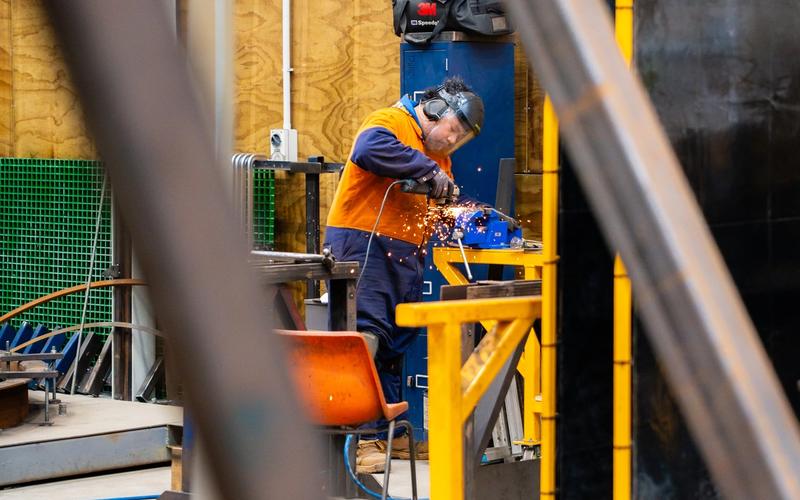
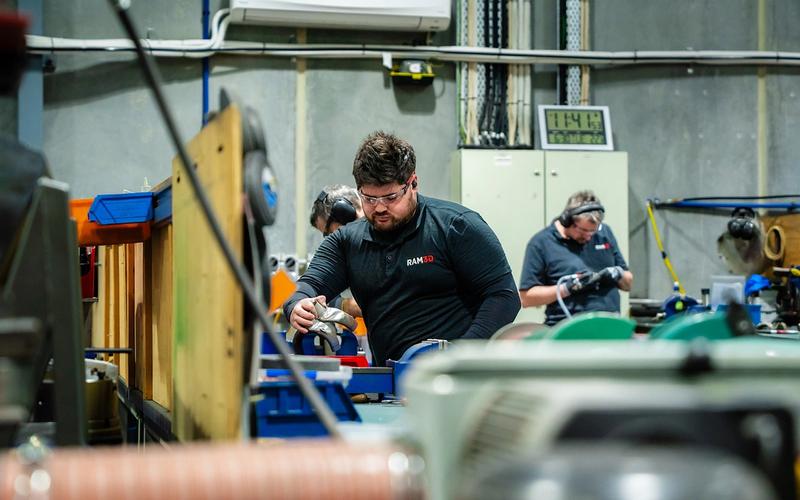
Hawk’s machinery is designed, fabricated, wired, programmed, assembled and supported by teams connected to one another in Hawke’s Bay.
Mechanical designers can speak directly with fabricators. Software engineers can stand beside the physical machine and see what their code is doing in the real world. The people installing and servicing the equipment can bring customer feedback straight back into product development.
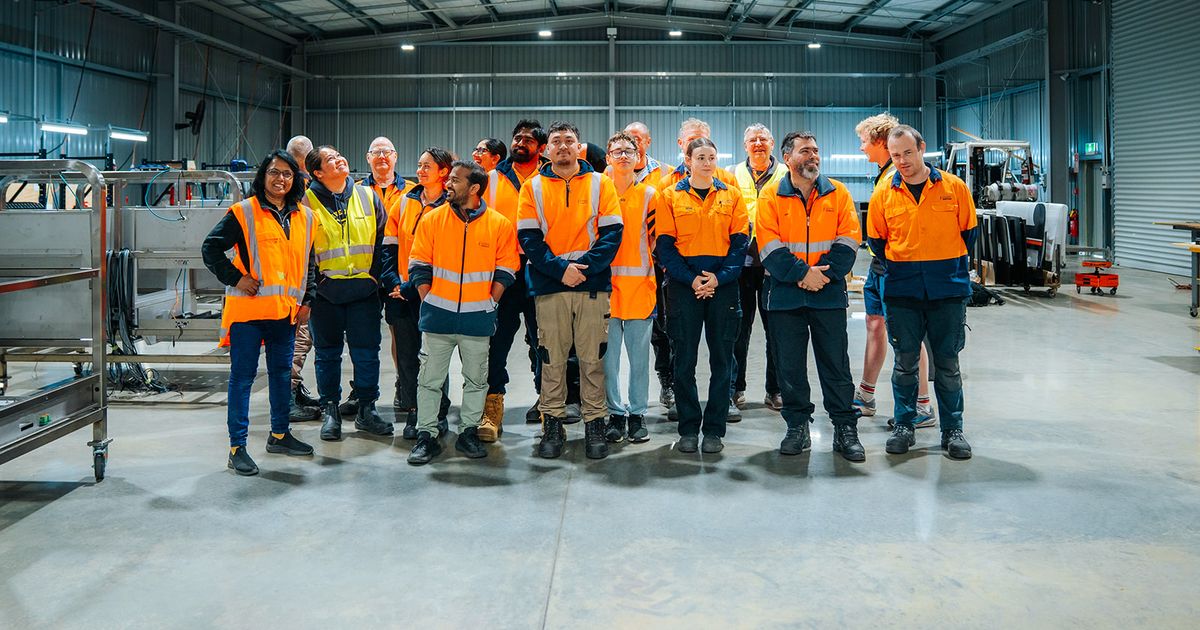
“We’re a turnkey solution,” says Managing Director Tim Combs. “Right from the guys who’ve designed something, to the guys who make it, to the guys who install it, we’re all in the tent together.”
That shared ownership continues after the sale.
“If you have a problem, you pick up the phone and talk to us,” Tim says. “We’re not pointing fingers at someone else. If there’s a problem, that’s on us.”
Seven years ago, Hawk says it had just two people working in research and development. Today, Hawk Technology has grown to more than 50 people across R&D, mechanical design, software, electrical systems, fabrication, assembly, project delivery and technical service.
Tim describes his role less like a conventional executive and more like a coach.
“I don’t have a mortgage on all the good ideas,” he says.
The goal is to put the best team on the field, make the game plan clear and ensure everyone knows they are allowed to contribute.
“Our superpower is our culture,” Tim says. “I don’t care if you’re 20 and you’ve been here five minutes, or you’re one of our software designers - everyone has the ability to contribute.”
More than one way into the machine
Hawk needs people who understand orchards. It needs people who understand electricity, fabrication and mechanics. And it needs people who can write the software that makes a robot see.
Tom grew up on a Hawke’s Bay orchard, helping with fencing, tractors, packhouse equipment and machinery. In his final year at school he was enrolled for university, then reconsidered.
“I didn’t really like book work,” he says. “I thought, I’ll jump into an apprenticeship and see what happens.”
He trained as an electrician with a local business before joining Hawk. Five years later, his role spans electrical systems, installations, service, customer support and the realities of keeping machinery operating through a harvest.
His advice is refreshingly low pressure.
“Give it a go,” Tom says. “I don’t think anyone’s going to hold it against you if you change your mind after six months. You might be surprised.”
Ben Kloosterman, Senior Mechatronics Engineer, came through another door.
He played with Lego as a child, built his own computer and taught himself programming before studying mechatronics. Today, he writes and refines the software that tells the machine how to inspect, orient and pack each apple.
“It’s one thing seeing it work on a computer in a perfect world,” Ben says. “Then you put it onto the real machine, make adjustments and keep improving. That’s the exciting part.”
For Ben, university was not the end of the learning.
“University is really about learning how to teach yourself how to do things — and to keep learning.”
Sam’s pathway was different again. He wanted to drive diggers, went to law school and eventually found his way back to the family business.
Together, those journeys make the point clearly:
There is no single type of Future Maker.
Automation changes the work
Hawk says the Gen 5 packer can reduce labour requirements by up to two people per packing lane.
But the context matters.
Many customers are not automating roles they can easily fill. They are responding to persistent seasonal labour shortages, rising production costs and short harvest windows in which every hour of downtime matters.
The machine absorbs repetitive, difficult-to-staff tasks while increasing the need for people who can operate, monitor, maintain and improve the technology.
Hawk’s own growth reflects that shift. What began as a solution to labour scarcity has created work across robotics, software, mechanical design, electrical automation, fabrication, project delivery, installation and service.
Automation changes the work.
It does not remove the need for capable people.
Made in Hawke’s Bay. Packing fruit in Washington.
Hawk’s first major international breakthrough has come in Washington State - the centre of the United States apple industry.
By July 2026, the first 50 Gen 5 Apple Packers had been installed there, with another 250 on order. Sam Combs says the US apple market is around seven times the size of New Zealand’s, and demand is already running ahead of Hawk’s current manufacturing capacity.
For Hawk, Washington is not simply another regional sale.
It is proof that machinery developed around New Zealand horticulture can compete inside a market many times larger than its home base.
“The biggest misconception is that it can’t be done here,” Sam says. “That you’ve got to send the electrical component to Asia, outsource this part and outsource that part.”
Hawk chose another model.
“We’ve just done it all here ourselves,” he says. “We’ve got a team that gets on with it.”
Inquiries are also coming from Europe, Australia and South America.
But the immediate challenge is scaling carefully enough to deliver what has already been promised.
A circular story - with less waste at every step
Hawk’s wider story still begins with recovered material.
Its packaging business turns reclaimed paper into moulded-fibre trays designed to protect fruit in storage and transit. Its technology business then creates the machinery that feeds, fills and inserts those trays inside a packhouse.
The Gen 5 packer adds another layer.
Its compact design can be retrofitted into existing infrastructure. Its power demand is low. And its controlled, consistent fruit handling is designed to reduce bruising so more of a grower’s crop can reach the market in export-quality condition.
None of those improvements is sustainability theatre.
They are practical decisions:
Use recovered material.
Retain useful infrastructure.
Handle the product gently.
Waste less of the harvest.
Why it matters for New Zealand
Hawk Technology proves that sophisticated robotics, software and artificial intelligence can be designed and built in regional New Zealand - not simply imported.
It creates highly skilled careers in Hawke’s Bay across mechanical engineering, mechatronics, software, electrical automation, fabrication, assembly, installation and service.
It also builds valuable intellectual property on top of an industry New Zealand already understands deeply.
The company’s advantage did not come from observing horticulture at a distance. It came from years spent alongside tray customers, packhouse teams and the fruit itself.
That knowledge is now becoming an export.
“The stuff we’re making here in Hastings is going around the world,” Ben says. “It’s a really unique opportunity for Hawke’s Bay.”
Every machine sold overseas helps demonstrate that New Zealand’s primary industries can be a launchpad for advanced technology - not only a market for it.
Looking ahead
Over the next few years, Hawk wants to increase its manufacturing capacity, deepen its presence in North America and establish itself as a recognised global leader in intelligent post-harvest automation.
Apples remain the immediate focus.
But the same combination of computer vision, gentle handling and compact automation has potential across stone fruit and other produce.
International growth will require more engineers, software developers, electricians, fabricators, installers and service specialists - many of them based in Hawke’s Bay.
Through all of it, the intention is clear:
Grow globally.
Retain the knowledge here.
Keep improving the machine.
Tim is the first to admit there was no perfect master plan.
“It evolved because our customers came to us with a problem and said, ‘Can you help us out?’”
Hawk said yes.
Make your move. Make your mark.
Your future might begin in a Hawke’s Bay workshop - writing code, wiring a control panel, fabricating a frame or testing a machine with real fruit.
One day, it could take you to Washington State to install a robot that can see an apple.
Designed in Hawke’s Bay. Built for the world’s harvest.