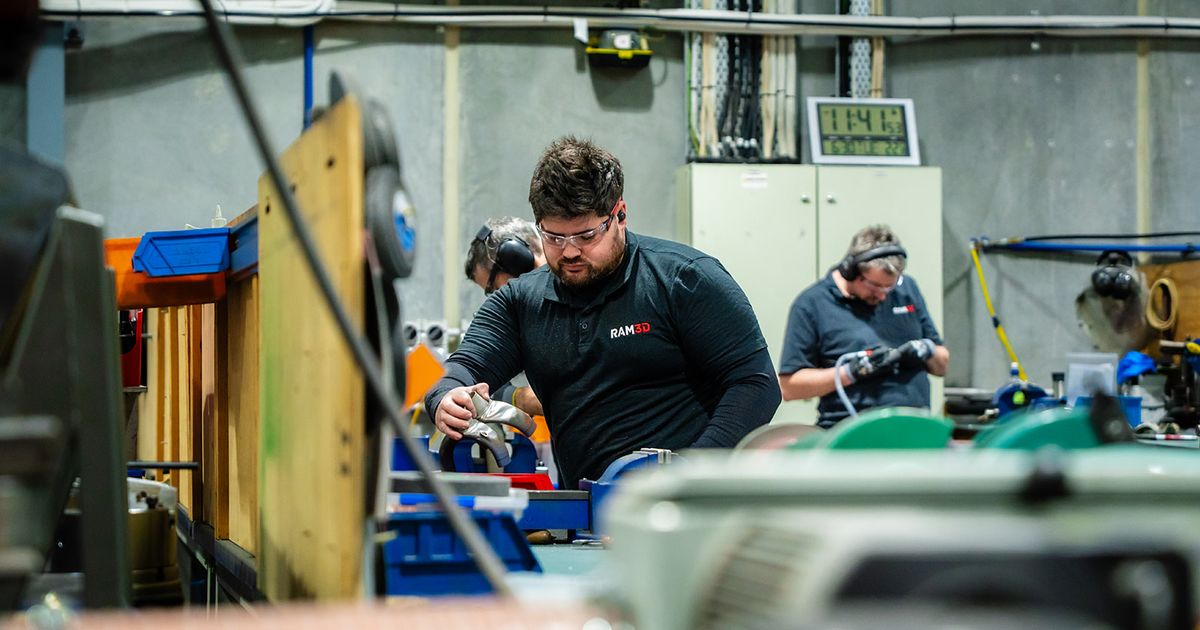
In a workshop in Tauriko Business Park, a short drive from the Port of Tauranga, a bank of lasers is quietly fusing metal powder into solid parts.
Some are bound for racing bikes and boats. Some for aircraft and spacecraft. And some have travelled a good deal further than that.
RAM3D - short for Rapid Advanced Manufacturing - is the largest independent metal 3D printing service in the Southern Hemisphere. It takes customers’ digital designs and builds them in titanium, stainless steel and Inconel, layer by layer, for aerospace, marine, energy, defence, cycling and industrial applications around the world.
The company says more than 90% of what it makes ultimately leaves New Zealand, either directly or inside its customers’ products.
Some of it leaves the planet.
“We’re right from the depths to the heights and everywhere in between,” says co-founder and CEO Warwick Downing.
From first machine to full-scale production
RAM3D grew out of New Zealand’s earliest work in metal additive manufacturing.
Warwick was part of the team that installed the country’s first metal additive-manufacturing machine in 2008. In 2012, Rapid Advanced Manufacturing was established as a commercial spin-off from the Titanium Industry Development Association, taking an emerging research capability and building a production business around it.
What began with one unfamiliar machine has become a substantial industrial operation.
RAM3D now runs 16 metal 3D printers in Tauranga, with another being added. The company says it produces an average of 13,000 to 15,000 parts each year and has passed the milestone of 30,000 printed aerospace components.
The shift has been important.
This is no longer a workshop producing the occasional unusual prototype. Many customers begin with one trial component, refine the design, prove its repeatability and then move into full production.
One part may become ten. Ten may become hundreds.
The machines keep changing what is possible, but RAM3D’s real advantage lies in the expertise developed around them.
“Technology is the base of our business,” Warwick says. “But people are what drive that technology.”
Building what other methods can’t
Most metal components are traditionally made by cutting material away from a solid billet.
RAM3D works in the opposite direction.
It uses a powder-bed-fusion process known as selective laser melting. A laser traces each cross-section through a bed of fine metal powder, fusing one thin layer at a time — often in increments of around 50 microns - until a dense, functional component has been built.
That approach enables shapes traditional tools cannot reach: internal channels, integrated structures, complex curves and lightweight geometries built into a single component.
“A lot of the internal components we produce in aerospace can’t be made by subtractive manufacturing, by generic CNC,” says General Technician Will Kitt. “They can only be produced by the additive process.”
The materials are chosen for demanding environments.
Titanium 64 provides exceptional strength without unnecessary weight. Stainless steels 15-5PH and 316L offer combinations of strength, corrosion resistance and performance across aerospace, marine and industrial applications. Inconel 718 and 625 withstand the extreme temperatures and pressure found in propulsion, energy and exhaust systems.
The process can also consolidate several fabricated pieces into one printed component.
Workshop Manager Phil Owen recalls a manifold that had previously been assembled from multiple parts. It was heavy, time-consuming to make and prone to leaking.
“We just turned around and 3D printed it,” he says, “and we solved a whole bunch of problems in one hit.”
Quality in every layer
Metal 3D printing may begin with a digital file, but the machine cannot guarantee the outcome on its own.
Every build depends on a controlled combination of laser energy, gas flow, powder quality, positioning, temperature, heat treatment and finishing. RAM3D has developed its own system for collecting build data and maintaining traceability through that process.
Once a part leaves the printer, the work may still be far from finished.
Supports are removed. Surfaces can be media blasted or polished. Titanium components are heat-treated to relieve the stresses created during printing, while spacecraft-grade stainless steel and Inconel parts can be treated in an argon atmosphere to prevent surface oxidation. Where a customer requires tighter tolerances or a machined interface, RAM3D’s growing in-house CNC capability completes the job.
Will began on the printers and now spends much of his time in final inspection.
“I love inspection,” he says. “I like making sure things are coming out right and that they’re going to make the client happy.”
In aerospace, energy and other mission-critical sectors, that final confidence is not an optional extra.
It is part of the product.
Tauranga to lunar orbit
One of RAM3D’s most memorable programmes reads like science fiction.
Over an intense few months, the team worked with an aerospace customer through weekly design, manufacturing and testing cycles for a satellite propulsion system. The project included printing components in a material not generally used for propulsion, requiring RAM3D to refine its own production methods as the design evolved.
The launch remained on schedule.
And the completed propulsion system helped power the spacecraft into lunar orbit.
RAM3D was not designing the entire spacecraft or propulsion platform. Its role was equally important: taking rapidly evolving designs and repeatedly producing the complex, flight-ready components the wider system required.
For a Tauranga manufacturing team, it was the clearest possible proof of what additive manufacturing — and the people behind it — could achieve.
The project also reflects how modern aerospace development works.
Design. Print. Test. Learn. Repeat.
Each cycle moved the customer closer to launch, while building RAM3D’s own knowledge of materials, manufacturing settings and mission-critical production.
From titanium hinges to Olympic bikes
Not every project is headed for space.
That variety is part of what keeps the workshop interesting.
“We’ll be doing a high-end boat part one day and rocket parts the next,” Phil says. “Oil and gas one day, car parts the next. There’s such a varied array of projects.”
One customer approached RAM3D because they needed a titanium toilet-seat hinge for an exceptionally high-end boat - a small but exacting component they could not source elsewhere.
Another brought the team a premium corkscrew, where the weight, feel, movement and finish mattered enough that the finished product could sell for hundreds or even thousands of dollars.
The company has also produced performance parts used in Olympic track cycling and America’s Cup campaigns, alongside components for automotive, energy, defence and industrial customers. The detail of some projects remains protected by confidentiality agreements, but the underlying challenge is consistent: make something complex, make it repeatedly and make it work.
That is where additive manufacturing earns its place.
It is not the right answer for every part.
But for the right design, it can remove tooling, combine multiple components, reduce material use and place weight only where the structure requires it. In aerospace and transport applications, that can also mean less mass carried through the working life of the vehicle.
No single path into metal 3D printing
For all the advanced equipment, RAM3D’s people have arrived through remarkably different routes.
Warwick trained in epidemiology and had previously worked as a builder. Phil began in architectural design before moving into machining. Will came through a welding apprenticeship and brought his understanding of metals, heat and fabrication into a technology he had never used before.
“I don’t have a university degree. I’ve got a trade,” Will says. “Everything I’ve learned here has been on the job.”
That is common at RAM3D.
There is no standard apprenticeship that teaches someone its complete laser-based metal-printing process. New starters learn the company’s proprietary systems, material behaviour, powder handling, quality expectations and machine processes inside the workshop, supported by people who have already travelled the same learning curve.
The pathway can begin at an entry-level station and lead into machine operation, inspection, CAD, CNC machining, customer support or production leadership.
Jaden Green is near the beginning of that journey.
He joined as a Workshop Technician after deciding school and university were not the path he wanted to follow. His early work involves cleaning the machines, preparing build plates, handling powder safely and learning what happens before and after a print.
“School wasn’t really for me, and I didn’t see myself going to university,” Jaden says. “When the opportunity to work here came up, I took it - and I’ve really enjoyed it.”
He does not pretend to know exactly where the role will take him.
But he now has a place to begin, people willing to teach him and daily exposure to a technology few New Zealanders ever see.
The route matters less than the curiosity and attitude someone brings with them.
Made in New Zealand, chosen globally
RAM3D knew from the beginning that New Zealand alone would not provide a large enough market for the capability it was building.
Export was not an extra.
It was part of the model.
Warwick believes advanced technology gives New Zealand manufacturers a genuine opportunity to compete internationally.
“Technology is the levelling playing field,” he says. “By applying it well, we can compete with anyone.”
Phil sees the proof in customer conversations.
A UK customer recently told him they had tried sourcing comparable work elsewhere but could not achieve the same quality they received from Tauranga.
“There’s a huge element of pride in that,” Phil says. “We’re directly responsible for the quality that leaves here.”
RAM3D’s location is not treated as an excuse.
It is simply the place the company chose to build from - supported by the Port of Tauranga, a growing regional engineering community and a global customer base increasingly comfortable collaborating across borders and time zones.
“We do like to be quite humble in what we do,” Phil says. “But New Zealand is a country of innovators.”
Why it matters for New Zealand
RAM3D keeps a rare and highly specialised manufacturing capability in New Zealand.
It creates skilled work in the Bay of Plenty, gives local aerospace and engineering companies access to mission-critical production close to home and brings high-value export revenue back into the country.
The benefit extends beyond RAM3D’s own workshop.
Customers learn how to redesign parts for additive manufacturing. Tradespeople and technicians gain experience in an emerging production technology. Every successful aerospace, marine or industrial project strengthens New Zealand’s reputation as a country capable of producing complex, high-consequence components.
In 2024, New Zealand ranked third globally for the number of annual orbital launches — a remarkable position for a country of its size. Companies such as RAM3D form part of the advanced manufacturing infrastructure that makes that wider aerospace story credible.
A small country does not need to manufacture everything.
But it can become exceptionally good at the things that are difficult to make.
Looking ahead
RAM3D is still adding capacity.
More printers. More machining capability. More people. And new materials that will open further applications in aerospace, energy, robotics and industrial manufacturing.
In 2026, the company reported that it was operating 16 metal printers, with its 17th machine on the way. It is also continuing to expand CNC capability and investigate further materials and sectors.
But growth is not simply about filling the workshop with equipment.
RAM3D’s deeper advantage is the knowledge accumulated around those machines: how materials behave, how designs should change, how quality is controlled and how a component moves from first prototype into repeatable production.
“The opportunities are endless,” Warwick says. “As the technology evolves, we’re able to do more.”
His advice to someone starting out is equally practical:
Do not wait for the perfect job.
Find a good place to begin, bring the right attitude and stay open to where the opportunity leads.
“You never know where an opportunity could take you,” Warwick says. “There is never a job that is too small. It really comes down to how you approach it.”
Make your move. Make your mark.
Your future might begin in a lecture theatre, through a trade, or on a Tauranga workshop floor learning how a laser turns metal powder into something the world has never made before.
One day it could be an Olympic bike. The next, a spacecraft headed for lunar orbit.
Printed in Tauranga. Built for what comes next.