Somewhere in the world today, someone may move closer to an answer about their health - and one of the tiny reagents behind that test was purified in Lower Hutt.
AROTEC Diagnostics is a Wellington biotechnology manufacturer that has spent around 30 years producing high-purity antigens and antibodies for autoimmune diagnostic systems. Almost all of what it makes is exported, reaching laboratories and diagnostic manufacturers to over 30 countries.
The scale of AROTEC's impact is not reflected in the physical size of its products. Materials small enough to fit in the palm of a hand can help deliver reliable diagnostic answers to patients around the world.
In this kind of manufacturing, value is not measured in tonnes.
It is measured in purity, consistency and what each milligram makes possible.
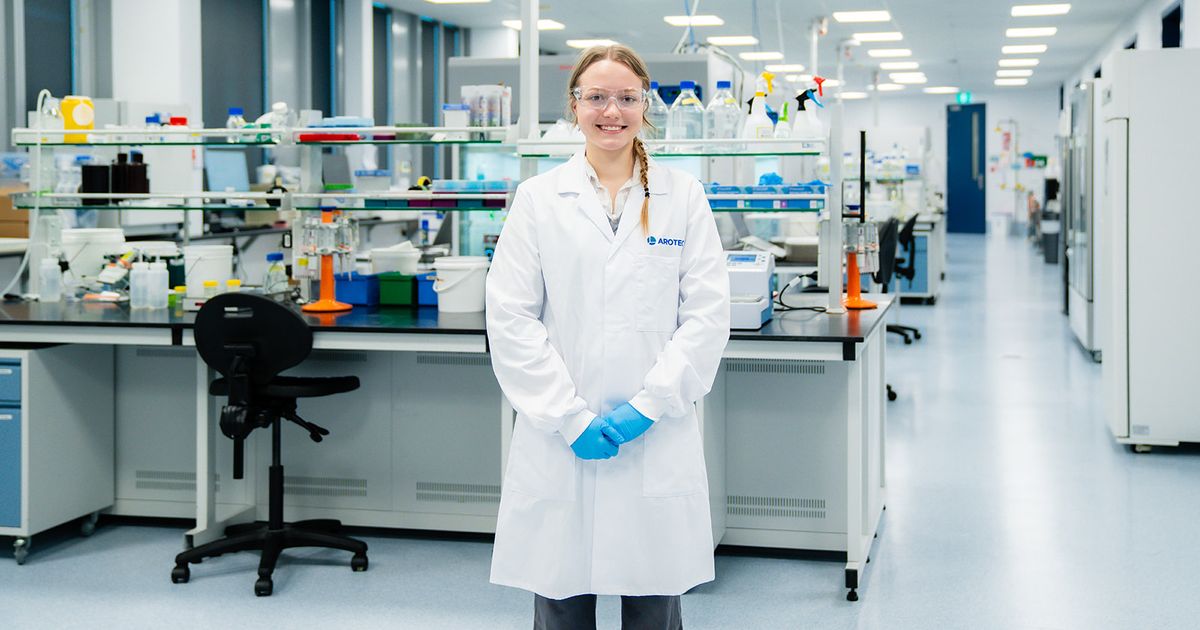
“Here at AROTEC, we make proteins that go into diagnostic kits to help diagnose autoimmune diseases,” says R&D Associate Brooke McDonald.
This is manufacturing.
It just wears a lab coat.
Invisible manufacturing, real answers
The science is easier to understand than it first sounds.
When someone has an autoimmune disease, their immune system can produce autoantibodies that react against the body’s own proteins. Diagnostic tests are designed to detect those autoantibodies in a patient sample.
AROTEC manufactures the carefully controlled antigens and antibodies that allow those tests to work.
In coeliac disease, for example, one important target is an enzyme called tissue transglutaminase, or tTG. AROTEC produces a purified form that diagnostic manufacturers can use inside an assay to help detect the relevant autoantibodies.
The finished reagent may be measured in milligrams, but its quality matters enormously. If it contains unwanted proteins, reacts inconsistently or performs differently from one batch to the next, the reliability of the finished test can be affected.
“We’re in the background, and it’s a good feeling,” Brooke says. “You don’t want to be up front like doctors, but you still want to help.”
Purity is the product
On the production floor, the work involves carefully prepared buffers, purification columns, controlled process steps and a great deal of testing.
Brooke jokes that some might call it “potion making”.
But behind the lab coats is a highly disciplined manufacturing system: defined procedures, batch records, quality controls and repeatable processes that must deliver the same performance from one lot to the next.
AROTEC sets a minimum specification of greater than 90% purity for its autoantigens and tests its products for activity, specificity, reproducibility and stability. Its quality-management system is certified to ISO 9001:2015.
That consistency is especially important because AROTEC’s customers are not buying a visible consumer product. They are integrating a precise biological ingredient into a diagnostic system that must work reliably again and again.
A few milligrams can carry enormous value.
But only if every milligram does what it is supposed to do.
From source to vial: the New Zealand advantage
AROTEC’s portfolio includes native proteins sourced from human blood and animal-derived materials, recombinant proteins produced through biotechnology, and specialist antibodies.
For applicable native animal-derived products, the company describes its approach as farm to vial.
AROTEC controls the journey from ethically sourced New Zealand material through purification, testing and final supply. That visibility gives customers stronger traceability and greater confidence in the consistency of the finished reagent.
New Zealand’s geographic isolation, strict biosecurity controls and traceable source materials provide a genuine advantage. They help reduce biological risk at the beginning of the process and support access to demanding international markets.
“Because we are so far away from everybody else, and we don’t have a lot of the diseases other countries do, that really matters when you’re making material that goes into diagnostics,” says Dr Theresa Bryce, Director of Manufacturing & Innovation, who leads work across R&D and production at AROTEC.
The New Zealand advantage does not replace the science.
It gives the science a stronger starting point.
Getting paid to learn
For all the specialist science, one of AROTEC’s clearest messages is about people and pathways.
Brooke studied microbiology and immunology at the University of Otago, with pharmacology alongside them. She admits her 17-year-old self “definitely didn’t think I’d be doing this”.
Her degree gave her the scientific foundation, but the practical manufacturing knowledge came later.
“University is the basis of your knowledge,” she says. “But the practicality and the skills come when you start your job. There are heaps of intelligent people here who teach you things you’d never find out at uni.”
AROTEC is also supporting Brooke as she works towards a Master’s degree in biotechnology, allowing her academic learning and day-to-day manufacturing experience to develop together.
The attraction is not only the science.
“When I wake up in the morning, I don’t dread coming to work,” she says. “It’s a good feeling being excited about what I do.”
Creating your own opening
Associate Production Scientist Nia Kulkarni was so determined to enter biotechnology that she emailed AROTEC before a role was even advertised.
Her microbiology and immunology degree gave her useful laboratory experience, but manufacturing introduced an entirely different level of learning.
“I did a lot of lab work in my degree, but not a lot of manufacturing like here,” she says. “The majority of what I do, I learned on the job.”
That means learning AROTEC’s specialist purification processes, taking responsibility for assigned products and understanding how daily decisions on the production floor affect the quality of the final reagent.
What keeps her motivated is knowing the work goes somewhere meaningful.
“It’s nice to see you’re working towards something, and not just for money,” Nia says.
Her pathway carries a useful lesson for other young scientists: sometimes the first step is not waiting for the perfect vacancy.
It is putting your hand up and asking whether there might be a place for you.
Growing our own people
AROTEC’s specialist processes are not something most people arrive already knowing.
The company has to build much of that capability itself.
“People are the backbone of what we do,” Theresa says. “Without the people, we can’t do what we do.”
She joined AROTEC in 2019 as an R&D scientist and moved into management within months. Today, she works across the scientific and production sides of the business and takes particular pride in helping others grow into increasingly complex work.
“I do personally like growing people and developing them, and seeing them reach their potential,” she says.
That culture is visible beyond formal training.
Music runs through the production area, different members of the team compete for control of the playlist, and Wednesday morning tea might involve pizza, hash browns, cakes and a full-team catch-up.
It is not the silent, isolated “mad scientist” environment some people might imagine.
It is a manufacturing team: collaborative, social and working towards the same result.
Made in Lower Hutt, relied on around the world
AROTEC’s reach far outstrips its physical scale.
Approximately 99% of its products are exported, with Europe, China and the United States among its largest markets. Its reagents support international diagnostic manufacturers, while the specialist purification and production work remains anchored in Lower Hutt.
In 2026, AROTEC was named Manufacturer of the Year — FTE Under 50 at the Advancing Manufacturing Aotearoa Minister for Manufacturing Awards. A year earlier, it received both the Supreme Business Award and Excellence in Manufacturing at the Wellington Regional Business Awards.
For Brooke, the pride lies in the contrast.
“The fact that we’re in little old New Zealand at the bottom of the Pacific, and the product we’re making is going to China, the States, Europe and around the world — and that it’s us Kiwis doing it here — is a pretty good feeling.”
Theresa is equally keen to challenge the stereotype of what manufacturing looks like.
“We’re very specialised,” she says. “This is science manufacturing, and we actually make a difference.”
Why it matters for New Zealand
AROTEC proves that advanced manufacturing in New Zealand can mean a lab coat as easily as a welding torch.
It creates highly skilled roles in biotechnology, production, quality, engineering and operations. It generates export value from specialist knowledge rather than physical volume. And it gives science graduates a career pathway beyond the traditional academic-research route.
Every purification process refined here, every quality specialist developed here and every production scientist trained here strengthens a biotechnology capability New Zealand could not simply import when it needed it.
The company is also part of Gracefield’s wider cluster of laboratories, researchers and advanced-technology businesses — an ecosystem where proximity makes it easier to share knowledge, find talent and solve difficult problems.
Small proteins.
High-skill work.
Global impact.
Looking ahead
Over the next few years, AROTEC wants to expand its portfolio of diagnostic antigens and antibodies, deepen its global customer relationships, create more highly skilled roles and continue developing New Zealand’s next generation of biotechnology talent.
For young scientists, Theresa’s advice is to look beyond the pathway they may have been shown at university.
“A lot of young scientists think of the research pathway,” she says. “I jumped into industry early, and I’ve made my whole career here. It’s a valid alternative, and it’s a good place to be.”
That is what AROTEC makes visible.
Science does not have to remain inside a paper, a lecture theatre or a research institution.
It can become a repeatable process. A manufactured product. A skilled career. A small vial sent from Lower Hutt to the world.
Make your move. Make your mark.
Your future might not look like you expect.
It might look like a lab coat in Lower Hutt, refining a few milligrams of protein that help a patient somewhere in the world see a clearer answer.
Small proteins. Global impact.