A single frost, on a single night, can wipe out an entire season's crop in a few hours. For a grower, that can mean a year's work, and a year's income, gone by morning.
FrostBoss exists to help stop that. From its Hastings base, the Hawke's Bay manufacturer designs and builds the tall frost-protection machines that stand guard over orchards and vineyards, combining composite engineering, robotics, electronics, software, weather data and field service around one very expensive problem. It now supplies growers in more than 15 countries across six continents.
One night. One crop.
The science is simple, the stakes are not. On clear, still nights, colder air settles around the crop while a warmer inversion layer sits higher above it. A FrostBoss fan draws that warmer air down and mixes it through the colder air at canopy level, helping keep buds, flowers and fruit above their critical damage temperature. The most dangerous window is when the crop is budding, and it doesn't take a run of bad weather to do the damage. One frost, over one night, can be enough.
“Frost can destroy a crop in one night,” says Mike Sutherland, GM Operations. “Mitigating frost risk and protecting growers' livelihoods is why we come to work every day.”
From imported machines to a New Zealand-built system
FrostBoss did not begin as a manufacturer. The business was established in 1995, initially importing wind machines from the United States. By 1999, the team had begun designing and building its own frost fans in New Zealand, adapting the technology around the growers, conditions and communities it served. In 2007 it became New Zealand Frost Fans, refining its blade systems, controls, monitoring and service model, and FrostBoss is now its global master brand, carrying Hastings-built technology into growing regions around the world.
That change mattered. Instead of accepting the limits of an imported machine, the team could start asking what it could make quieter, more efficient, easier to monitor and better suited to the people operating it.
It's all in the blade
“I'm probably a little biased, because I look after the blade factory, but I believe it's the blades,” says blade manufacturing manager Jarrad Piper. “They're quieter, they're more fuel-efficient, and they just look better.”
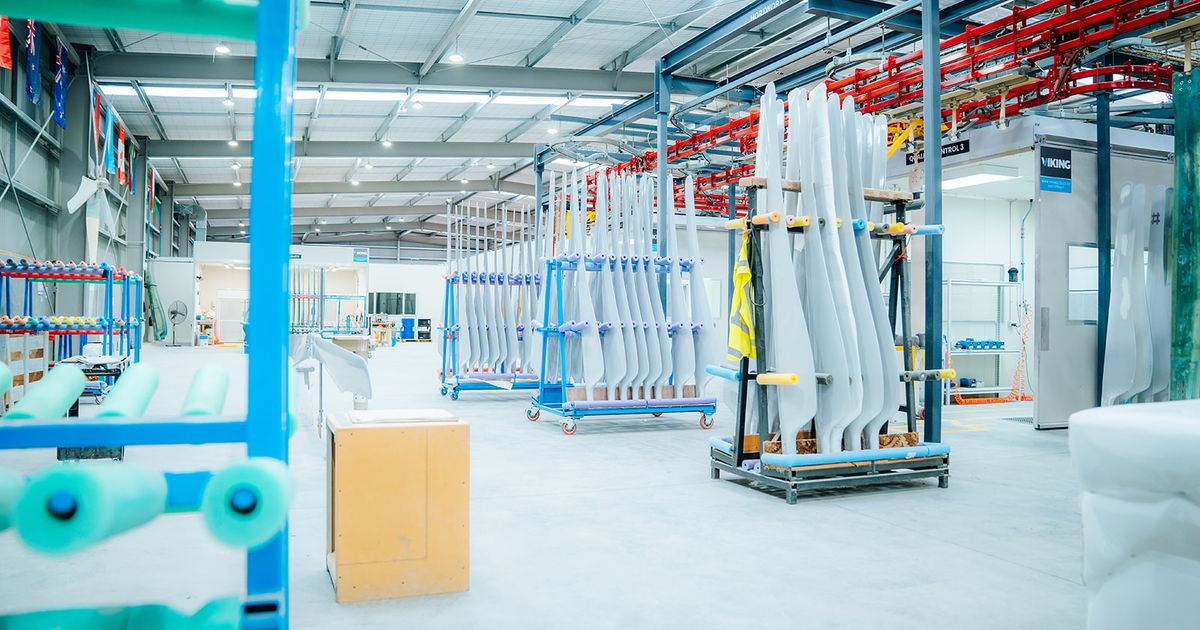
FrostBoss offers three-, four- and five-blade configurations. Each composite blade weighs around 17 kilograms, measures roughly two to 2.7 metres long, and must be carefully balanced before assembly, on towers that stand more than 10 metres above the orchard. Inside each blade is a foam core wrapped in fibreglass and a proprietary resin system, a combination that gives it the strength, lightness and controlled flex to withstand years of rotation and changing wind loads.
But the real advantage is in the shape. FrostBoss engineers the blade angle and working surface from root to tip so the whole length contributes useful airflow. That lets the machine protect a broad area at lower engine speeds, cutting both fuel use and the low-frequency “chop” associated with traditional two-blade machines. Depending on the model and conditions, the company lists coverage of roughly six to eight hectares per fan, using around 20 to 21 litres of diesel an hour, against about 37 litres for a standard two-blade system.
Robotics changes the work
Producing a high-quality composite blade means moulding, curing, trimming, filling, sanding, coating and repeated inspection. Several of those finishing stages were traditionally manual, and dusty, repetitive and physically demanding. FrostBoss's new blade facility now uses robotics for parts of the sanding and painting process, improving consistency and capacity while reducing exposure to some of the most hazardous, repetitive work.
The people have not disappeared from the process. They prepare the materials, oversee the equipment, resolve imperfections, finish the blades and make the final quality calls. FrostBoss says the new facility has tripled its blade-manufacturing capacity, and Jarrad says it is designed to produce up to 48 blades a day.
The frost fan on your phone
The hardware stands more than 10 metres above an orchard, but the grower doesn't have to stand beneath it to know what's happening. FrostBoss's FrostSmart platform connects compatible fans to a digital system that can show tower and canopy temperatures, wind conditions, fuel and battery levels, alarms, faults and operating history. Depending on the installed controller and service tier, growers can also adjust settings and start or stop a fan remotely. That matters on a frost night, when one person may be responsible for several machines spread across a large property, and when every minute counts.
Quieter, more efficient, and now electric
FrostBoss's environmental story starts with efficiency. Its blade systems are designed to create useful airflow at lower engine speeds, reducing fuel use and noise through long overnight frost events. The company also upgrades older frost fans with new composite blades, controllers, engines and monitoring, improving infrastructure that is already standing rather than replacing it wholesale.
FrostBoss says its compatible systems can run on approved HVO renewable diesel, and that it has developed a propane option for selected European and South American markets. Its newest step is electric: the company’s first electric model is now protecting cherries at an orchard owned by Alex Gimenez, founder and CEO of Patagonia Chocolates, in Central Otago. The move opens another pathway for growers who can tap suitable grid or on-site renewable power.
More than one way into the factory
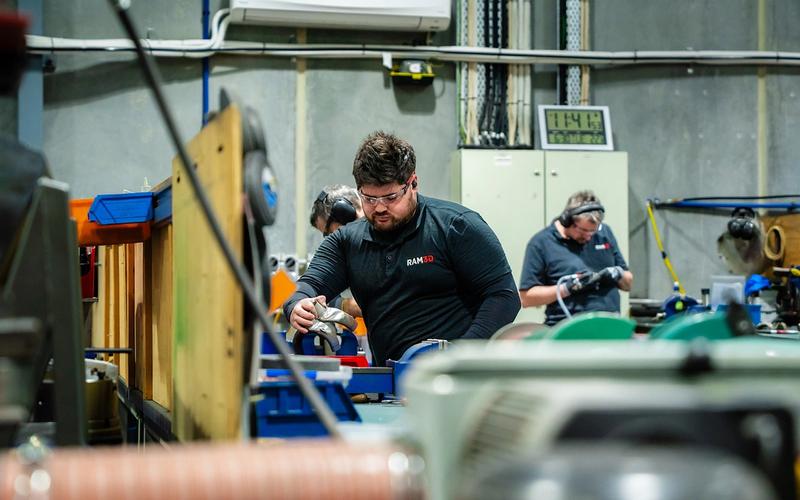
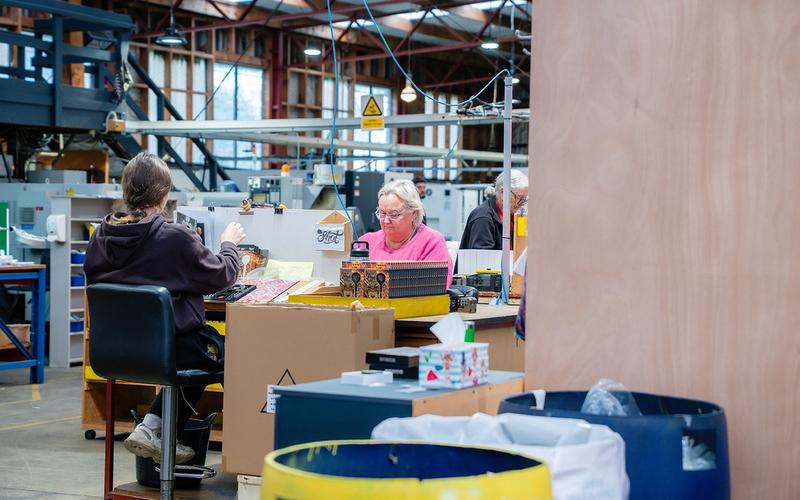
Around 60 people work across FrostBoss's Hastings operation, from composite-blade manufacturing and final assembly to electronics, software, installation and service. Few arrived by a straight line. Keeley Piper came from construction when work in that industry slowed, with no composite-manufacturing background and little enthusiasm for the classroom. Today he prepares raw materials, assembles the blades before paint, and helps turn fibreglass, foam and resin into a highly engineered finished product.
“What surprised me about manufacturing was their willingness to train you,” he says. “There are so many support systems, and bosses who care about you. You never stop learning.”
Gabriel Ymbong came through an entirely different door. In the Philippines he trained as a criminologist and worked in law enforcement; since joining FrostBoss in 2019 he has learned to assemble PCB boards, wiring looms and electrical systems for machines shipped around the world.
“Everything I do here, I learned on the job,” he says. “I thought manufacturing was boring, but it's challenging. Knowing the parts I build go all over the world is very rewarding.”
Their journeys reflect one of FrostBoss's clearest values: we are family, and we keep each other safe.
Built in Hastings, protecting crops worldwide
FrostBoss machines now protect orchards and vineyards across New Zealand, Australia, Europe, Canada, South America and other growing regions. The company says it supplies more than 15 countries across six continents, with new markets continuing to open. As New Zealand Frost Fans, it was named Hawke's Bay Exporter of the Year in 2021, and in 2024 it took the ExportNZ Hawke's Bay Judges' Choice Award. For the people building the fans, that reach still feels slightly surreal.
“We ship things all around the world,” Jarrad says. “What we make here in little Hawke's Bay is going everywhere.”
Why it matters for New Zealand
FrostBoss is a reminder that world-class technology can be developed and exported from a regional town. It creates skilled jobs across engineering, electronics, software, production and service in Hawke's Bay, brings export revenue home, and builds tools that help protect food production against an increasingly unpredictable climate. Designing and manufacturing locally, rather than importing, keeps that capability, and those careers, in the community.
Looking ahead
Over the next few years, success for FrostBoss means taking its Hastings-built technology into more crops and growing regions while continuing to improve both the product and the way it's made. That means scaling the robotic blade facility, developing the electric range, using FrostSmart data more intelligently, and refining the noise, fuel use, reliability and service life of the machines. It also means creating more opportunities in Hawke's Bay across composite manufacturing, robotics, software, electronics, installation and technical service.
FrostBoss encourages young people to seek out practical experience before assuming a pathway isn't for them; programmes such as the local R&D Experience Grant can give tertiary students a first look inside businesses where engineering, software and manufacturing meet. The company's advice is simple: stay curious, ask questions, and say yes to learning. The people who succeed aren't necessarily those who know everything on day one. They're the ones who keep looking for a better way.
Make your move. Make your mark.
Your future's calling, and it's quieter than you think. It might look like a composite blade in a Hastings factory, spinning through a cold night somewhere in the world to help protect a season's harvest.