When professional players step up on some of darts’ biggest stages, some are throwing tungsten barrels machined in a small factory in Katikati.
Shot Darts is a family-owned New Zealand manufacturer of high-performance darts. From the Bay of Plenty, its team designs, CNC-machines, coats and match-weights tungsten barrels before sending them to players and retailers across dozens of countries.
Shot Darts is a family-owned New Zealand manufacturer of high-performance tungsten darts. From the Bay of Plenty, its team designs, CNC-machines, coats and match-weights high-end tungsten barrels before sending them to players and retailers across dozens of countries.
But precision is only part of what makes the company different.
“We’re storytellers at heart,” Shot says. “Every dart we make tells a story, from its point to its flight.”
From a port strike to the world stage
Shot’s story began in 1970, when port strikes disrupted imported sports equipment and John and Pat McCormick saw an opportunity to make darts locally.
They established Puma Dart Products in Katikati, exporting their first darts just two years later. Over the decades, the business evolved from producing coiled paper dart boards and brass darts into a design-led international company specialising in precision tungsten products.
Peter McCormick stepped into the Managing Director role in 2003, and in 2009 Puma Dart Products became Shot Darts — a name and identity designed to take the company’s own products onto the world stage.
One of its most influential milestones arrived in 1991 with The Bandit, recognised by the company as the world’s first bladed dartboard. Replacing traditional round wire with thin blade dividers reduced bounce-outs and helped change the way competition dartboards were made.
“They changed a round wire for a blade wire,” says Luke Pickering, Shot’s Product Manager. “It reduced the bounce-outs and changed the game.”
The company has changed significantly since then, but its appetite for finding a better way has stayed firmly intact.
“I’m very proud to be part of this business,” Luke says. “It’s gone from a family-run operation to an international company that competes on the world stage.”
Every dart tells a story
Shot calls it its saga culture.
Each range begins with a narrative, and that story is carried through the name, graphics, grip pattern, colour treatment, barrel finish and packaging. Some draw on Aotearoa-inspired themes and cultural motifs, developed with local creative collaborators.
“People look for a story in our products,” Luke says. “We develop that story and carry it through the dart barrel and the packaging.”
It is a deliberately different approach in a category where products can otherwise appear technically similar.
The barrel still has to feel right in the hand. Its grip, weight distribution and geometry still need to perform. But Shot also wants a player to connect with the product before the first dart is thrown.
That combination of engineering and narrative has become part of the company’s global identity.
“Darts can often look and feel very similar,” the company explains. “Our breakthrough is treating every dart as its own story.”
Precision-made. Finished by hand.
Every barrel begins as a cylindrical tungsten-alloy billet.
The front is prepared for its point and the rear is drilled and threaded before the material moves into CNC machining, where programmed tools cut the grip, shape and balance profile.
The barrel may then move repeatedly between machining and coating. A layer of colour or titanium finish is applied, sections are cut back to expose the tungsten beneath, and another coating may follow. It is this combination of subtractive machining and layered finishing that creates the detailed patterns Shot is known for.
The company also operates its own titanium coating plant, giving the team greater control over product development, quality, consistency and lead times.
At the final stage, sets are match-weighted to within five-hundredths of a gram before being checked and packed. Shot also backs its tungsten barrels with a lifetime guarantee.
“What we manufacture here is pretty unique,” says Operations Manager Josh Honey. “People see darts in a pub and think it’s pretty basic. It’s a little bit different from just a piece of metal.”
Some products are deliberately manufactured in small runs, allowing the business to keep developing new ideas without surrendering the quality and detail that distinguish them.
Learning and earning
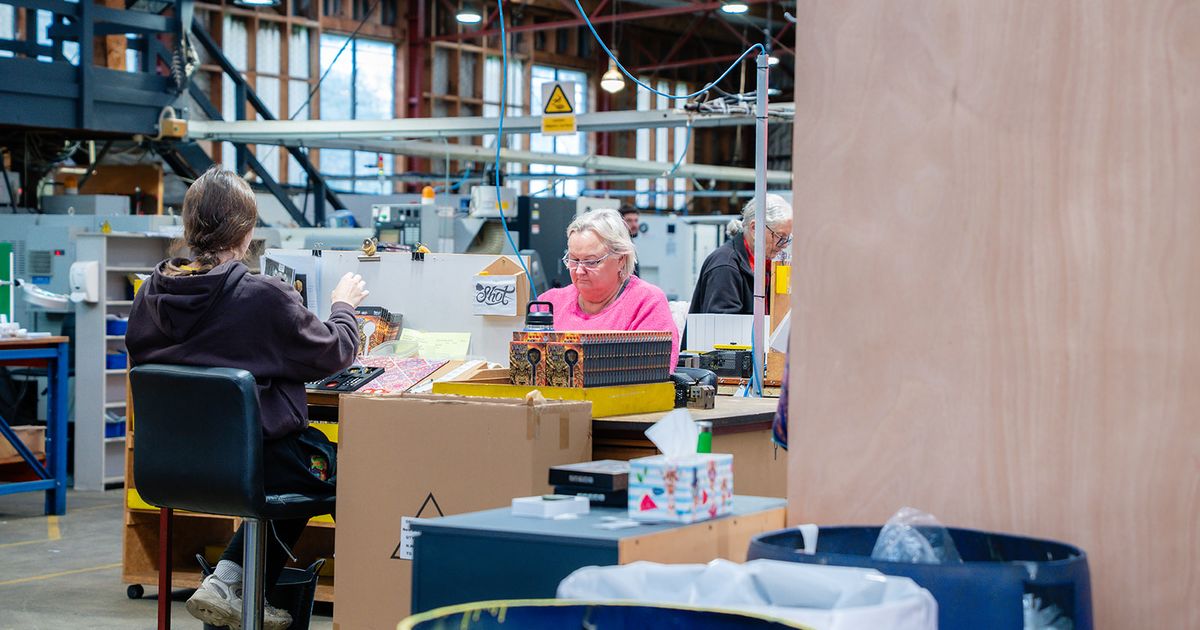
Behind the technology is a young team, much of it trained on site.
Luke Pickering joined Shot as a graphic designer. His role gradually expanded into product and industrial design, time on the factory floor and the development of new processes for the titanium coating plant.
“It was all trained on site in this factory,” he says.
For Luke, the most satisfying moment is seeing a design make the transition from screen to finished product.
“You put a lot of blood, sweat and tears into them,” he says. “They’re your little babies when you’re designing them, and then you get to hold them in your hands. There’s something rewarding about that.”
Fitter machinist Troy Ewart entered the industry through pre-trade training before moving north and completing his apprenticeship at Shot. Over more than five years, he learned to programme and operate the CNC machines from the ground up, supported by block courses, assessments and study completed alongside his work.
The qualification has given him more than technical ability.
“It gives me confidence,” Troy says. “And it gives my kids someone to look up to.”
His advice to anyone considering the same path is straightforward:
“You’re getting paid while you learn, and that’s awesome. You could be making rocket parts, aerospace, medical - or you could be making darts.”
The product may be specialised, but the skills are highly transferable: precision machining, CNC programming, maintenance, production problem-solving and quality control.
As Josh puts it: “You’re learning and earning at the same time. You’re going to figure out what you like, and the things you can’t do, you’re going to learn how to do.”
Growing leaders from within
Shot’s investment in young people goes well beyond teaching someone how to operate a machine.
Several years ago, the business deliberately brought in a cohort of emerging talent and backed them for the long term. It mentored them, created room for overseas experiences and found ways for personal ambitions to fit alongside work.
Today, members of that cohort are helping lead the business — and some hold shares in its future.
It is succession planning in its most practical form: do not wait for capability to arrive from somewhere else. Find good people, teach them, trust them and give them a reason to stay.
“It doesn’t just happen,” the company says. “You have to be flexible and creative to make it work.”
That people-first culture also shows up in smaller ways. Shot describes itself as having a good old Kiwi “sausage roll culture”: on special occasions - or after the odd experiment that does not quite land — someone cooks a batch for morning tea and the team gathers in the kitchen.
It is a simple tradition, but a revealing one.
A global business can still feel like a local team.
Small town. Global stage.
While much of the international darts industry outsources production, Shot keeps the design, machining and coating of its tungsten barrels in Katikati.
“We fly under the radar,” Luke says. “When people come here, they’re always surprised and impressed that we’re doing all this out of a little corner in Katikati.”
The company’s largest markets include the United States and the United Kingdom, with a Dallas warehouse supporting its growing American customer base. But the manufacturing knowledge remains anchored in the Bay of Plenty.
Ask Luke whether New Zealand undersells what it makes and the answer is pure Kiwi:
“We don’t boast about it, but we do it well. We do it bloody well.”
For Troy, the global reach is still difficult to comprehend.
“It blows me away to know that we’re making something that’s going to end up on the other side of the world.”
Why it matters for New Zealand
Shot Darts proves that high-value precision manufacturing does not require a major city or a massive domestic market.
It keeps CNC machining, coating, industrial design and product-development capability in a small Bay of Plenty town. It creates pathways for local people, supports a wider network of suppliers and carries New Zealand-made products onto some of the sport’s biggest international stages.
Keeping the barrel-making process in Katikati also keeps control, technical knowledge and the pride of making close to home.
The company’s story challenges two persistent myths at once: that manufacturing has to be large-scale and repetitive, and that global sporting products must come from offshore factories.
Shot is building something more distinctive.
Highly technical products. Made in considered runs. With their own story to tell.
Looking ahead
Shot maintains a steady rhythm of new releases, with new ranges arriving roughly every three months. That pace keeps the entire business moving: new sagas, new grip geometries, new finishes and new challenges for the machines on the floor.
Over the next few years, its ambition is to keep expanding internationally, grow the team across its markets and have more leading players choosing Shot when they step up to throw.
Awards are not the measure that matters most here.
The real endorsement is seeing a player make the winning shot with a product that began as an idea — and a raw tungsten billet — in Katikati.
Make your move. Make your mark.
Your future’s calling - and it might begin with a tungsten billet, a CNC programme and a product thrown on the world stage.
Crafted in Katikati. Built to win.