The lawns at Windsor Castle. The Old Course at St Andrews. The trackside verges at Silverstone.
There's a good chance they were all cut by a machine built in Tauranga.
From its base in the Bay of Plenty, Trimax Mowing Systems designs and builds tractor-powered commercial and industrial mowers, the kind known as “mowing systems” rather than consumer machines, and exports them around the world. Founded in 1981, the family-owned manufacturer has built, sold and serviced more than 33,000 mower decks, with manufacturing and support across New Zealand, the UK, the US and Australia. Its job isn't just to cut grass. It's to keep some of the most demanding turf on the planet in show condition, season after season, decade after decade.
From a kiwifruit orchard to the global stage
Trimax began with a single real-world problem. In the early 1980s, founder Bob Sievwright developed a mowing blade for Bay of Plenty kiwifruit orchards. That instinct, solving a genuine problem a customer had in the field rather than building a product and hunting for a market, still runs through the business today.
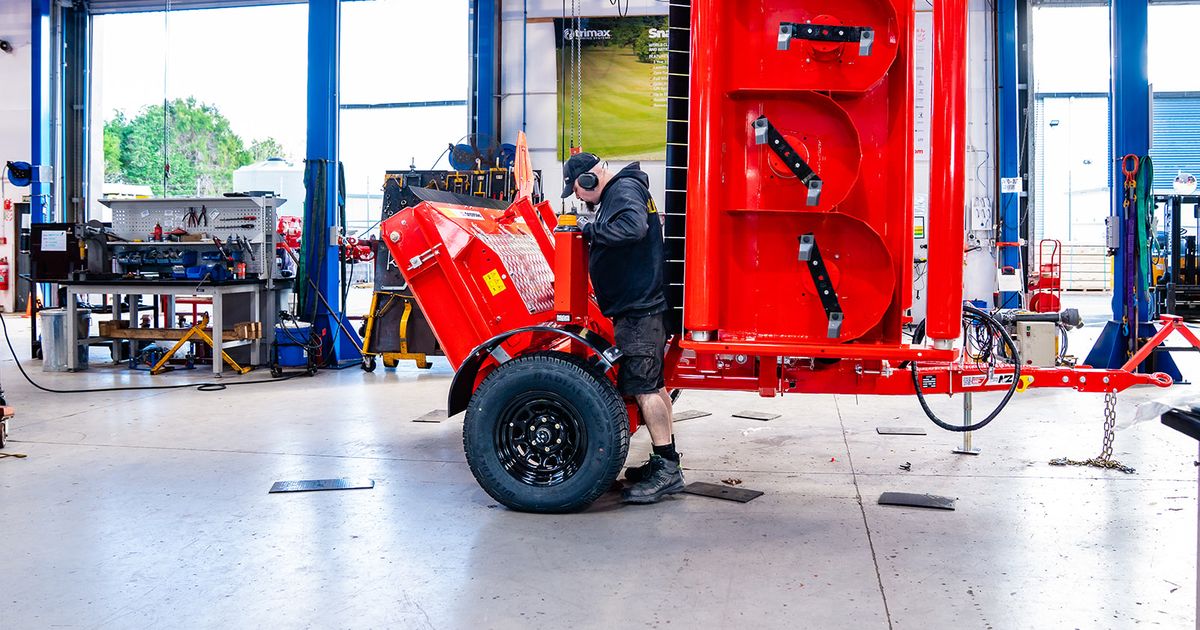
More than four decades on, Trimax designs and builds machines like the Pegasus roller mower, the Stealth wing mower and the latest-generation Snake, sold into turf, sports, municipal, golf and horticultural markets. It has grown into a genuinely global company while staying a family one at heart. Bob's son, Michael Sievwright, has led it as CEO since 2018, having spent a decade in roles across the New Zealand, UK and US operations before taking the top job. Around half the workforce is now based in Trimax's international markets, but the engineering core remains firmly in Tauranga.
Engineering built to last
Ask the team what they're proudest of and the answer isn't a single invention. It's longevity. Trimax machines are regularly still running, and still being serviced, more than 20 years after they were sold. The grounds team at Windsor Castle, the company says, is still ordering spare parts for a mower bought in the 1990s.
That durability is a design philosophy, and the team keeps engineering the maintenance burden out over time. The latest-series Snake removed 12 of the daily grease points its predecessor required. It sounds small, until you multiply it across a council fleet running through a full season, cutting downtime and the chance of a missed service.
Behind the machines sits a 25-strong engineering team spanning mechanical, electronic and software disciplines. New designs are tested with grass-cutting simulations, high-speed cameras and CFD modelling. That is computational fluid dynamics, which lets engineers see how air and clippings move through a mowing deck on screen before a single blade is cut. On the floor, robotics is changing how the machines are built.
“To make one of these manually would take an operator about three hours,” says production engineer Neidene Rodrigues, who programs Trimax's welding robots. “The robot does it in about 45 minutes, with much better consistency.”
Neidene studied mechanical engineering, moved into design, then taught himself robotics on the job, and newer offline programming tools have cut the time to set up a weld from days to hours. “I had no prior experience,” he says. “The key thing I learnt was being open, asking questions, taking feedback from the guys on the floor. That's where the real gains come from.”
More than mowers, and more than one trade
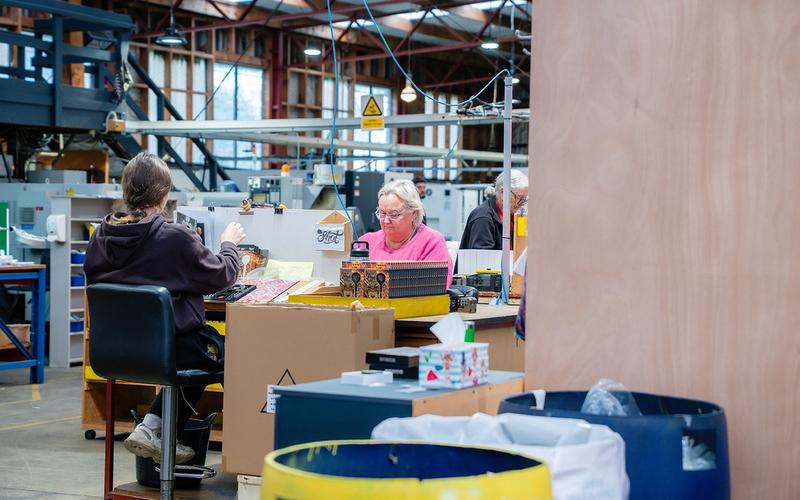
Walk through Trimax and the stereotype of a factory floor falls apart quickly. Under one roof there are welders, fabricators, painters, electricians, robotics and automation technicians, product designers, mechatronics engineers and an in-house R&D team. It means there are many ways in, and few of the people here arrived in a straight line.
Assembly technician Kieren Shelley builds wiring looms, motors and control boxes, and runs the 3D printing for components made in-house. He came to it via a turf farm and then council mowing around Tauranga, operating the very machines he now helps build.
“I'd always wanted to be an engineer, but I put it off for a few years,” Kieren says. “Now I get to do my hobby as my job. I'm proud that stuff I've built personally could end up on the other side of the world.”
For Sahil Sharma, now second-in-charge of the paint department, the change was bigger still. He arrived from a retail and IT background with no coating experience at all, and learned wet painting, powder coating and sandblasting from the ground up. “I always wanted a hands-on career where I could learn different skills,” he says. “Over these five years at Trimax I've learned all of them, and that's what made me a 2IC.”
It's a pattern that repeats across the business: people backed to grow, and trusted to own their patch. Mechatronics engineer Waldo, a boilermaker by trade who later added a mechanical engineering degree, now designs the electronics, motors and mobile apps that control the machines, all picked up in the job. He describes the work with a grin: “It's a bit like MythBusters. We bring our ideas to life, we build them, and we get to test them.”
Made in New Zealand, wanted worldwide
Trimax mowers work on some of the most demanding surfaces in the world, from royal grounds to PGA Championship golf courses and top equestrian and polo fields, alongside hundreds of councils, sports fields and municipal parks across its markets. The company has been named Bay of Plenty Exporter of the Year more than once, most recently in 2025, and is consistently ranked among New Zealand's leading technology exporters. Crucially, it manufactures and supports in-market rather than simply shipping from home, which means local lead times and local service for customers a hemisphere away.
“It's little New Zealand creating a product that is world-renowned,” Kieren says. “People don't always realise we can build big manufacturing companies here: welders, engineers, R&D, electricians, all in one building.”
Why it matters for New Zealand
Manufacturing at this level does more than ship machines overseas. It anchors high-skill jobs in the regions, brings global knowledge home, and supports a web of local suppliers, subcontractors and service partners across the Bay of Plenty. Every export sale helps sustain not just Trimax's own team but the Tauranga businesses around it, and when a locally built machine performs at Windsor Castle or Silverstone, the whole region shares in the reputation.
Looking ahead
Success over the next few years, the team says, looks like becoming the recognised global leader in grounds care: building more local capability in international markets, pushing further into automation, software and electric drivetrains, and growing the next generation of Trimax engineers and technicians from within. As Bob Sievwright proved in 1981, big careers can start with one practical problem worth solving. Look past the stereotype of the factory floor, the team says, and modern manufacturing needs robotics technicians, software and electronics engineers, designers and marketers alongside the traditional trades. Find a problem worth solving, get stuck in, and be willing to learn.
Make your move. Make your mark.
Your future might not look like you expect. It might look like a welding torch, a line of code, or a 3D printer in Tauranga, building the machines that keep the world's most famous turf in shape.
The Future Makers is an Advancing Manufacturing Aotearoa initiative, produced by MEL.