There’s a good chance you’ve used something Tilley & Patton made without ever knowing it.
The bench you sat on. The bin you walked past. The perforated metal screen on a car park or building façade.
“I could take you down the road and everyone interacts with our products every day,” says Managing Director Daniel Lincoln.
From its Lower Hutt workshop, Tilley & Patton manufactures street and park furniture, architectural metalwork, perforated panels and custom-engineered components for councils, architects, construction companies and other manufacturers. Much of the work is bespoke and produced in short runs.
“We’re almost never doing the same job twice,” Daniel says.
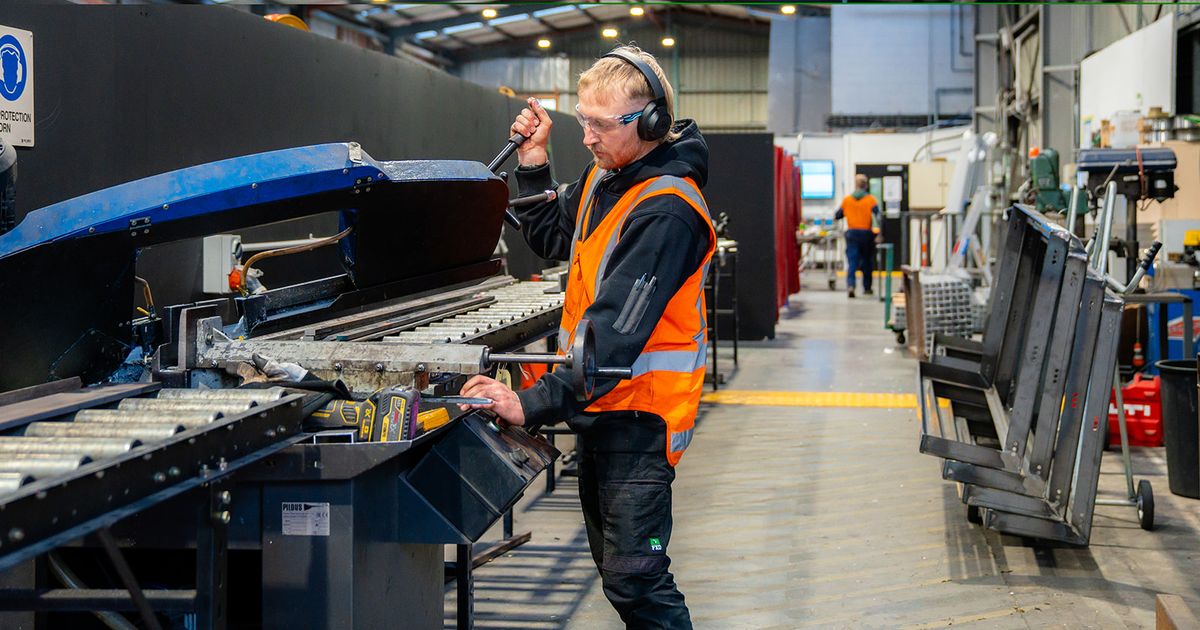
Across the floor, stainless steel, aluminium and mild steel move through turret punches, laser cutters, folders, weld bays and assembly - transforming raw material into the public infrastructure New Zealanders encounter every day.
A century of history - and still an early adopter
The story begins in 1921, when Arthur Ernest “Ernie” Tilley arrived in Wellington from Tasmania with £10 borrowed from his mother and a bag of tools.
What began in motor-body components and repair gradually evolved into A.E. Tilley, a specialist sheet metal manufacturer. Under later Tilley-family leadership, the company became one of New Zealand’s early adopters of computer numerically controlled machinery, investing in new technology as manufacturing shifted from manual processes to digitally controlled production.
That instinct to move with the times remains part of the company’s character.
Following its acquisition by the Patton Group in 2025, the business was renamed Tilley & Patton. It now combines more than a century of Tilley manufacturing heritage with the added capability, resources and scale of the wider Patton Group.
The machines may have changed dramatically since 1921.
The desire to make useful things well has not.
Modernising a century-old workshop
Daniel is clear that innovation is not always about inventing something entirely new.
“Sometimes it’s about looking at an everyday process and asking, ‘Why are we still doing it this way?’”
One of the company’s biggest challenges was visibility. Like many manufacturers, Tilley & Patton had plenty of information, but not enough meaningful data to support better decisions.
Optimising its ERP system - the software that tracks jobs, materials and production activity - gave the business a stronger foundation. The team has since introduced better production tracking, digital workflows and artificial intelligence into quoting, product development, documentation and process improvement.
Daniel sees AI as a force multiplier, not a substitute for the people who understand the work.
“AI, as a tool in our company, is making people more productive,” he says.
One practical example sits among the racks of perforated plate.
The team used AI to help develop a colour-coded, map-based system for locating stock. Previously, an operator could spend several minutes searching for the correct sheet — and occasionally select the wrong material. Now, each location and product code is easier to identify, making picking faster and stock control more accurate.
“It’s not going to make the perforated metal for us. It’s not going to run the machine for us,” Daniel says. “But it can organise information so the guys can just come out and go, ‘I want that.’”
It is a simple improvement.
But that is often what good process innovation looks like: less time searching, fewer errors and more attention available for skilled work.
Still backing young people
Ask Daniel what he is proudest of and he talks about people, not products.
“I’ve always had a heart for investing in young people. I see them as the future of our industry.”
That investment also protects the knowledge already inside the business. As experienced operators approach retirement, newer trainees create a pathway for specialist skills to be passed on rather than lost.
Tilley & Patton is developing training pathways that give people more than familiarity with a single machine. The aim is to help them understand how the process works, why it works and where it can be improved.
“We’re trying to give people something they can hold at the end and say, ‘I can do something,’” Daniel says.
That “something” is bigger than a piece of paper.
It is confidence. Portable capability. A stronger foundation for whatever comes next.
Two different roads into manufacturing
Daniel knows the value of a second chance because he needed a few himself.
He left school at 16 and later dropped out of a polytechnic engineering course. After recognising he was heading in the wrong direction, he returned to high school as an adult student.
He did not make it to industrial design school. Instead, a labouring job at a Hawke’s Bay engineering company led to a fabrication apprenticeship, years of practical experience and eventually a decade managing an engineering business in Napier.
Today, he leads Tilley & Patton.
“The 18-year-old me never would have dreamed I’d get here,” he says.
His advice to others who may not have found their place at school is direct:
“It really doesn’t matter that much how you did at school. It’s the attitude you bring to work.”
Kieran Aitken is at an earlier point in his own non-linear journey.
After working across fisheries, hospitality and dispatch, he came to Tilley & Patton through a MSD employment pathway in the Hutt Valley. He began in dispatch and is now training across the turret punch, laser, guillotine and pressbrakes while working through a CNC operator skills module.
The CNC turret punch uses programmed coordinates to position sheet metal and create precise holes and forms. It is technical, practical work — and for Kieran, there is still plenty to learn.
“I’ve come in here and I’m learning so much,” he says. “These are things I’m going to use in my future.”
The earn-as-you-learn model is part of the appeal.
“It’s quite a privilege to get paid while I’m learning,” Kieran says.
Four months in, he is not pretending to have his entire career mapped out.
But he has his foot in the door, people willing to teach him and a growing set of skills he can carry forward.
Sometimes that is exactly how a future begins.
Made here, used every day
Tilley & Patton’s work is overwhelmingly made for New Zealand - and Daniel sees real value in that.
“It’s really nice to see they’re being made here by New Zealanders,” he says of products people may assume arrived in a shipping container.
He also wants to challenge the idea that manufacturing means repeating one simple task all day.
“People think it’s putting a cap on a bottle,” Daniel says. “We make very bespoke, very small-run, very intricate things that are hard to import.”
That ability to solve specific problems quickly is one of the advantages of manufacturing locally. Customers can work closely with the people designing and making the product, refine it as a project evolves and avoid forcing a complex requirement into an offshore, off-the-shelf solution.
It is not manufacturing at the greatest possible volume.
It is manufacturing at the right scale, for the right problem.
Sustainability by design
Durability is also part of the sustainability equation.
Tilley & Patton designs public infrastructure to last for decades, while better nesting, smarter material utilisation and more efficient production help reduce scrap before fabrication begins.
For a bespoke manufacturer, making only what is needed — and making it properly — is one of the most practical forms of waste reduction.
Legacy, for Daniel, also means keeping advanced manufacturing capability in New Zealand.
Every process retained here keeps knowledge onshore. Every person trained creates another link in that chain.
Why it matters for New Zealand
A company like Tilley & Patton does more than make benches, bins and architectural screens.
It keeps advanced sheet metal capability alive in New Zealand. It turns raw material into infrastructure used by communities every day. It creates skilled work in the Hutt Valley and gives experienced tradespeople an opportunity to pass their knowledge to the next generation.
It also demonstrates that modern manufacturing is not an industry from the past.
“I’d like to see New Zealand back itself,” Daniel says. “Manufacturing isn’t yesterday’s industry. It’s one of tomorrow’s.”
Looking ahead
Over the next five years, Daniel wants Tilley & Patton to be recognised as one of New Zealand’s leading sheet metal manufacturers - a place where skilled people, modern machinery, better data and AI work together to produce exceptional products.
But success is not simply about becoming a bigger business.
It is also about helping more people see manufacturing as a high-tech, rewarding career with room to grow.
“My advice is to be prepared to start at the bottom and never stop learning,” Daniel says. “The technology has changed enormously, but the people who succeed are still the ones who keep learning, adapting and thinking outside the box.”
Make your move. Make your mark.
Your future’s calling - and it might come through a side door.
A century of craft. The latest machines. And a Lower Hutt manufacturer proving there is more than one way into a skilled career.