At Oasis Engineering in Tauranga, some components are designed for hydrogen systems operating at pressures of up to 700 bar.
That is roughly 300 times the pressure inside a typical car tyre.
At that pressure, a valve is not a small piece of hardware. It is a safety-critical system — and failure is not an option.
Oasis designs and manufactures high-pressure valves, couplings, manifolds, nozzles and refuelling components for compressed natural gas, renewable natural gas, hydrogen and other demanding gas-transfer applications. Oasis exports 90% of what it makes, with its products now used in more than 40 countries.
Managing Director Kevin Flint has a clear picture of where that work might lead.
“In 20 years’ time, I’m filling my vehicle with hydrogen,” he says, “and it’s using products that were designed and made by the guys here in Tauranga.”
From soft drinks to high-pressure gas
Oasis’s story began in the 1980s, inside the maintenance division of a Gisborne soft-drink manufacturer.
When that operation was restructured, its machine-shop capability became a standalone engineering business and later moved to Tauranga. The new company built a reputation for machining high-tolerance components in demanding materials, and one of the products moving through the workshop was a ball valve for compressed natural gas.
It proved to be more than another job.
The valve helped establish Oasis in the growing CNG market, and in 2007 Kevin joined the business to develop a broader range of components for natural-gas vehicles and refuelling infrastructure.
“Oasis has been manufacturing for its entire existence,” says Operations Manager Hadyn Natusch, who has spent close to three decades with the company. “It’s gone from soft drinks, into dairy, into gas, and reinvented itself along the way.”
In 2017, Germany’s ELAFLEX Group acquired a majority stake in Oasis. Five years later, it purchased the remaining shares, making Oasis a fully owned group company. That relationship added international distribution, specialist knowledge and wider product-development capability while keeping Oasis’s core engineering and manufacturing operation in Tauranga.
The company is reinventing itself again.
This time, the next frontier is hydrogen.
Where failure is not an option
High-pressure gas is unforgiving.
Every component must seal reliably, perform predictably and withstand the pressure cycles, temperatures and operating conditions it was designed for.
“We’ve spent decades solving engineering challenges that many companies never encounter,” Kevin says.
Oasis tests products throughout development and production, not simply after the design has been completed. Its Tauranga operation includes a hydrostatic rig rated to 4,000 bar, an environmental chamber that ranges from minus 80°C to plus 185°C, and dedicated in-house hydrogen-testing capability. Components are cycled, stressed and, where required, tested to failure so the team understands how they behave at their limits.
The aim is not only to see whether a component survives once.
It is to understand how it will perform over time, where the design needs refinement and what quality checks must be built into production before the product reaches a customer.
Oasis’s ISO 9001:2015-certified quality-management system covers the design, manufacture and supply of its precision-engineered components. Depending on the product and application, its work also aligns with recognised international pressure, performance and refuelling standards. Material traceability, controlled machining, inspection and testing support consistency from one batch to the next.
At Oasis, testing is not the final hurdle.
It helps shape the product from the beginning.
Start with the system, not the valve
Oasis does not begin product development by asking what it can add to a catalogue.
It begins with the customer’s operating problem.
How quickly must the gas move?Where is pressure being lost?How often will the component cycle?How easy will it be to service?What happens if a vehicle drives away while it is still connected?
Those questions influence the internal flow path, sealing system, materials, geometry and manufacturing process. In high-pressure applications, a small design decision can affect the performance of an entire station or transfer system.
That customer-led approach was one of the reasons Oasis won the 2025 ExportNZ ASB Bay of Plenty Excellence in Innovation Award. Judges recognised both its use of automation and robotics and the way its team uses design thinking and customer insight to understand the real needs behind a brief.
One result is the Ultra Fast Fill System®.
Rather than relying on one heroic component, the system brings together purpose-built valves, manifolds, couplings, breakaways and nozzles to improve the full CNG transfer path — from storage and priority panels through to the dispenser, vehicle or trailer.
By reducing restrictions and improving flow consistency, Oasis can help customers achieve faster fills and better transfer efficiency across the system as a whole.
Good engineering is not always about making one part more complicated.
Sometimes it is about making the complete system work better together.
Machines that work through the night
Oasis has moved through several generations of manufacturing technology.
When Kevin joined the business, its CNC machines were manually loaded. An operator placed a component into the machine, waited for the cycle to finish and then removed it before starting again.
The first automated bar feeder created understandable concern.
“Everybody started to worry they were going to lose their jobs,” Kevin says. “That didn’t happen. We just got better and better, more efficient, and able to lower our prices so we could sell more.”
Robots followed.
“I was a bit unsure,” Kevin admits. “It was quite a big investment. But within a month, we knew it was worth it.”
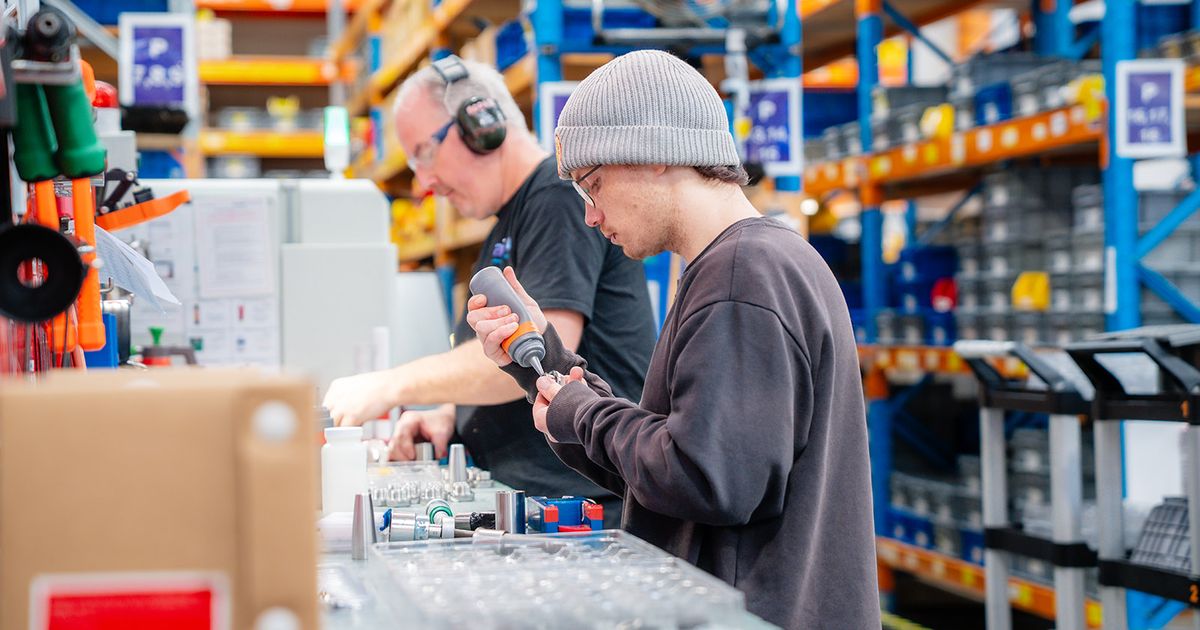
Oasis now operates 14 advanced Okuma CNC machines, supported by automated bar feeding and multiple robotic cells. Some production cells can continue running for long periods without an operator standing beside the machine, increasing output while allowing skilled people to focus on setup, programming, quality and process improvement.
Technology has not removed the need for people.
It has changed where their value sits.
Underneath the equipment is a culture of Kaizen — continuous improvement through practical changes led by the people closest to the work. Whether someone works in machining, engineering, assembly or the warehouse, they are encouraged to identify opportunities to improve quality, safety and efficiency.
The company is also assessing where artificial intelligence can add genuine value, rather than introducing it simply because it is available.
The test remains straightforward:
Does it make the work safer? Does it improve quality? Does it help the team work more effectively?
People before machines
“Manufacturing has always been about people before machines,” Kevin says.
Oasis’s career stories prove the point.
Hadyn left school unsure what he wanted to do. Once he was introduced to engineering, he found a love of machining and completed an apprenticeship in machining and toolmaking.
That foundation led into product design, further study in mechanical engineering, product development and, eventually, operations leadership.
The apprenticeship did not narrow his options.
It widened them.
“There are lots of different pathways,” Hadyn says. “But definitely get that trade behind you, because it opens so many doors.”
Today, as Operations Manager, Hadyn works across production workflows, lean manufacturing, logistics and team performance. Oasis’s current team profile records more than 29 years of experience with the company — knowledge built one product, one process and one improvement at a time.
Tanner Landon is closer to the beginning of that journey.
He started at Oasis at 16, helping around the workshop after school. Six months later, the company offered him an apprenticeship.
Today, Tanner is a CNC machinist apprentice who sets up equipment, programmes jobs and works through the detailed process of refining production until a component runs exactly as intended.
“I didn’t actually know I wanted to get into this until I was here,” he says. “I’d say give it a go, because I had no idea how interested I’d be until I started.”
In 2026, Tanner was Highly Commended in the Manufacturing Apprentice of the Year category at the Minister for Manufacturing Awards, recognised for his technical capability, initiative and commitment to process improvement.
He is equally clear about the earn-while-you-learn advantage.
“I’m earning money and getting educated,” Tanner says. “Not having a student loan is a very nice feeling.”
Alongside apprentices like Tanner are people who have spent more than 25 years at Oasis.
Their understanding of materials, products, machinery and failure modes cannot simply be downloaded from a manual.
It has to be passed on — one setup, one problem and one decision at a time.
Made in Tauranga, tested by the world
Oasis products are used across North America, Europe, Asia, Australasia and other international markets.
The company competes by combining precision machining, specialist product development, rigorous testing and responsive technical support — not by trying to be the cheapest supplier.
In 2025, ExportNZ described Oasis as a manufacturer of high-precision gas-control devices exported to more than 40 countries and recognised it as an exemplar in automation, robotics and alternative-fuel product development.
Kevin still remembers the contrast when he arrived from the United Kingdom.
“I was amazed at the can-do attitude, the number-eight-wire attitude,” he says. “It was breathtaking.”
For Hadyn, the global reach carries a quieter kind of pride.
“I feel so proud to be part of a global company based here in Tauranga,” he says. “We export all over the world, and we’re only just scratching the surface.”
The products may be small enough to hold in one hand.
The systems depending on them are anything but.
Infrastructure for the energy transition
Oasis does not produce the fuel.
It makes the hardware that controls it.
Its products support the storage, transportation, transfer and dispensing of compressed natural gas, renewable natural gas and hydrogen. The environmental outcome depends on how the fuel is produced and the wider system in which it is used, but the infrastructure challenge remains the same: alternative gases cannot scale if the components controlling them are unreliable, difficult to service or inefficient.
Oasis’s role is to make that infrastructure safer, more dependable and easier to maintain.
Longevity matters here too.
A component designed for long-term performance, supported by service kits and built to be repaired rather than prematurely replaced can reduce downtime for the customer and extend the useful life of the equipment around it. Oasis and ELAFLEX both place strong emphasis on durability, repairability and long-term product performance.
Sustainability, in this context, is not a slogan.
It is a product that keeps doing its job.
Why it matters for New Zealand
Oasis shows that high-value precision manufacturing can remain in New Zealand and compete internationally.
Its Tauranga operation creates skilled roles across engineering, CNC machining, assembly, testing, quality, logistics and product development. Export sales bring value back into the country, while apprenticeships and internal progression build capability that can support New Zealand manufacturing for decades.
Every engineer, machinist and apprentice developed here strengthens the country’s ability to design, manufacture, test and certify high-consequence products rather than relying entirely on offshore expertise.
The wider value is not only in the finished component.
It is in knowing how to make it.
Looking ahead
Over the next few years, success for Oasis means continuing to expand its hydrogen and alternative-gas portfolio while remaining an exceptional place to build a career.
That will require more skilled engineers and machinists, further automation and digital capability, and a new generation able to carry the company’s specialist knowledge forward.
Kevin’s own measure of success is more personal.
In 20 years, he wants to pull into a hydrogen station, connect the nozzle and know that the components controlling the pressure were designed and manufactured by the Tauranga team he helped build.
He also wants Oasis to be known for more than the products leaving its workshop.
He wants it recognised for the people who learned, progressed and became leaders inside it.
“Ultimately, we’d like Oasis to be recognised not only for the products we build, but for the people we develop.”
Make your move. Make your mark.
Your future might begin at a CNC machine in Tauranga, shaping a valve designed to control hundreds of bar of pressure on the other side of the world.
Precision made. Pressure tested. Ready for what comes next.
The Future Makers is an Advancing Manufacturing Aotearoa initiative, produced by MEL.